Soft Start vs. Hard Start Kits: Which Is Better for Your Florida AC?

Florida air conditioners work hard. In Port St. Lucie, Martin County, Indian River County, and North Palm Beach County, hot temperatures and high humidity can keep your system running for long hours. That makes reliable compressor startup especially important.
You may have heard that a soft-start device or hard-start kit can improve AC startup. These products can help, but they solve different problems.
A hard-start kit adds temporary starting torque. A soft-start device reduces startup inrush current. Neither option is automatically right for every system.
Use this guide to understand the difference and decide when to ask a qualified HVAC professional for an evaluation.
What Happens When Your AC Starts?
Your outdoor unit’s compressor requires a brief surge of electricity when it starts. This surge is called inrush current or locked-rotor amperage (LRA).
At startup, the compressor motor is not moving yet. It must overcome:
- Motor and compressor inertia
- Refrigerant pressure
- Mechanical resistance
- Outdoor temperature and system conditions
The compressor can briefly draw several times more current than it uses while running. This momentary demand may cause lights to flicker, a generator to bog down, or a breaker to trip if the electrical system is already under strain.
Startup also requires torque. Torque is the twisting force that gets the compressor motor turning.
Think of the difference this way:
- Inrush current: How much electricity the system demands at startup
- Starting torque: How much turning force the compressor receives
Hard-start and soft-start products affect these two factors differently.
What Is a Hard-Start Kit?
A hard-start kit usually combines a start capacitor with a relay or positive temperature coefficient (PTC) device. The capacitor provides a temporary boost to the compressor’s start winding. The relay or PTC device removes that start capacitor after the compressor reaches operating speed.

SUPCO SPP6 hard-start kit. Photo courtesy of SUPCO’s official product page.
The goal is simple: give the compressor more starting torque for a short period.
A hard-start kit may help an older compressor, a compressor starting against high pressure, or a system that has difficulty getting the motor turning even though its electrical supply and other components are in good condition.
Important: A Hard Start Does Not Reduce Inrush Current
A hard-start kit is not an inrush-current reduction device.
The added capacitor increases current in the start winding to create more torque. It may help the compressor accelerate faster, which can shorten the time that high current is present. However, it does not lower the true peak current at the instant of startup. In some cases, the peak may be higher.
As ICM Controls explains in its Soft-Start vs. Hard-Start guide, hard-start technology and soft-start technology address different startup conditions.
Hard-Start Kit Benefits
A properly selected hard-start kit may offer these advantages:
- Provides a temporary increase in starting torque
- Helps some older or mechanically tight compressors start
- May help a compressor start against higher pressure
- Can be a simple and relatively low-cost retrofit
- May shorten the duration of a difficult startup
- Works with many single-phase air-conditioning systems when properly matched
A hard-start kit can be useful when a compressor is slow to start, hums before running, or trips its overload during startup. However, those symptoms require diagnosis first.
Hard-Start Kit Drawbacks
Consider these limitations before installing one:
- It does not reduce peak startup current
- It may increase current in the start winding
- It does not solve a failing compressor
- It can mask mechanical or electrical problems
- Incorrect sizing or installation can damage components
- It is not a guaranteed solution for breaker trips or generator overload
- It may not be appropriate for every compressor design
Do not use a hard-start kit to hide a compressor that is failing. If the compressor has damaged windings, internal mechanical wear, low voltage, a failing run capacitor, or another serious problem, adding more starting torque may only delay the correct repair.
What Is a Soft-Start Device?
A soft-start device uses electronic controls to ramp voltage and current to the compressor instead of applying the full startup demand all at once.
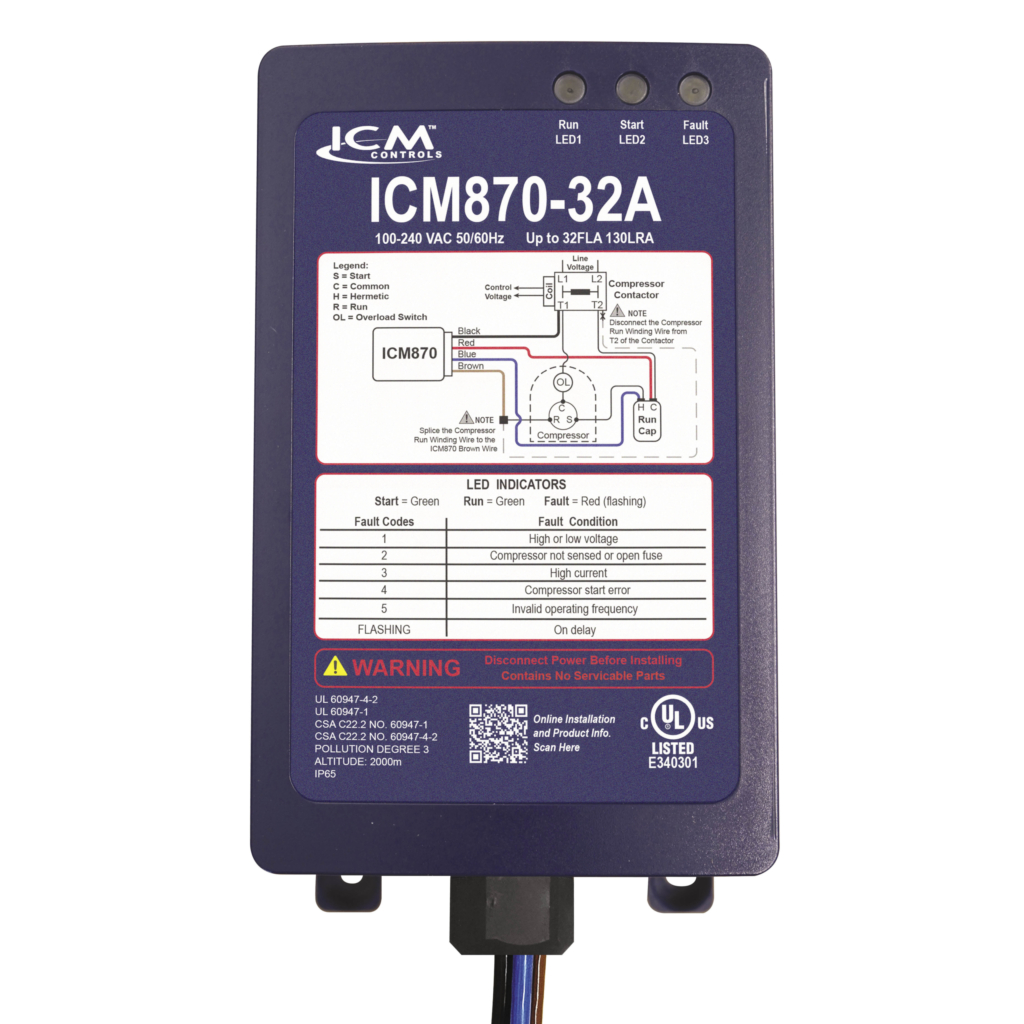
ICM870-32A soft-start device. Photo courtesy of ICM Controls’ official product page.
This controlled ramp reduces the compressor’s initial electrical demand. ICM Controls states that its ICM870 can reduce peak inrush current by up to 70%, depending on the application. Some other manufacturers claim reductions of up to 75%. Treat these figures as product and system claims, not as a universal result for every air conditioner.
A qualified technician should measure your equipment and select a compatible device based on the compressor’s actual electrical ratings.
Soft-Start Benefits
A soft-start device may be a strong choice when your main concern is electrical demand.
Potential benefits include:
- Substantially reduces startup inrush current
- Helps reduce light flicker and voltage sag
- May help prevent nuisance breaker trips
- Can improve compatibility with some generators and inverters
- Reduces the sudden electrical shock of a direct startup
- May create a smoother and quieter compressor startup
- Can reduce transient stress on certain electrical components
Soft starts are especially worth discussing if you want to operate your AC during a power outage with a properly sized generator. They may also help homes with limited electrical capacity or noticeable light dimming whenever the compressor starts.
A soft start does not guarantee that a generator can safely run your entire home. The generator still needs enough capacity for the AC’s running load and every other connected appliance.
Soft-Start Limitations
Soft-start technology has important tradeoffs:
- It costs more than many basic hard-start kits
- It does not provide the same temporary torque boost as a hard start
- It cannot repair a weak, damaged, or mechanically failing compressor
- It may require specific programming or setup
- It may not be compatible with some compressor control systems
- It does not guarantee lower monthly energy bills
- It does not guarantee a longer compressor life
A soft start can reduce the amount of electricity required during the brief startup event. Your air conditioner may still use roughly the same power while it is running and cooling your home. Do not purchase one solely on the promise of lower monthly utility costs.
Soft Start vs. Hard Start: Pros and Cons
| Option | Main purpose | Pros | Cons |
|---|---|---|---|
| Hard-start kit | Increase temporary starting torque | Helps some difficult-starting compressors; relatively simple; often lower upfront cost | Does not reduce peak inrush; may increase start-winding current; can hide a failing compressor |
| Soft-start device | Reduce and control startup inrush current | Can reduce startup demand; may help with generators, inverters, flicker, and nuisance trips; provides smoother starts | Higher cost; does not add the same starting torque; compatibility must be checked; does not guarantee lower bills or longer life |
Which Option Is Better for Your Florida AC?
The better option depends on the problem you are trying to solve.
Choose a Hard Start Only When Extra Torque Is Needed
A hard-start kit may be appropriate when:
- The compressor struggles to turn over
- The system has correct voltage and a healthy run capacitor
- A technician identifies a difficult starting condition
- The compressor is otherwise operating within acceptable limits
- Your electrical supply is adequate, but the compressor needs more starting force
Do not choose a hard start simply because someone promises it will lower starting amps. That is not its primary function.
Consider a Soft Start When Electrical Demand Is the Problem
A soft-start device may be appropriate when:
- Your generator trips or bogs down when the AC starts
- Your lights dim noticeably during startup
- A breaker trips at compressor startup
- You have limited electrical service
- You want to reduce startup demand on an inverter or generator
- You want a smoother startup for a compatible fixed-speed compressor
Ask your technician to evaluate the entire electrical system. A soft start will not correct undersized wiring, poor connections, low utility voltage, a failing capacitor, or a defective compressor.
Check Compatibility Before Installation
Do not choose a device based only on your AC’s tonnage. A professional should check:
- Compressor type and model
- Rated-load amperage (RLA)
- Locked-rotor amperage (LRA)
- Voltage and phase
- Run capacitor condition
- Contactor and wiring condition
- Control-board design
- Generator or inverter capacity
- Manufacturer installation requirements
Variable-speed inverter systems often use their own electronic compressor controls. They may not need an aftermarket soft-start or hard-start device, and adding one without approval can create compatibility problems.
ICM Controls also identifies compatibility concerns with certain Comfort Alert and Emerson CoreSense control arrangements. Always verify the specific equipment and controls before installation.

Have a professional inspect the capacitor, contactor, wiring, and compressor before recommending a start-assist device.
Installation Requires a Qualified HVAC Professional
Air conditioners contain hazardous electrical components, including capacitors that can retain an electrical charge after power is turned off. The outdoor unit also includes high-voltage wiring and moving equipment.
Do not attempt to install a soft-start or hard-start kit as a do-it-yourself project.
Have a qualified HVAC professional:
- Test the compressor and electrical components.
- Confirm the actual startup symptoms.
- Check voltage, RLA, LRA, and capacitor condition.
- Verify device compatibility.
- Install and secure the device correctly.
- Test startup performance after installation.
- Look for the underlying cause of repeated trips or hard starting.
Get an Honest AC Recommendation from Tropi-Kool
There is no universal winner in the soft-start versus hard-start comparison.
- Hard start: More temporary starting torque for a difficult-starting compressor.
- Soft start: Lower, smoother startup inrush for electrical-demand concerns.
Tropi-Kool provides honest recommendations for all makes and models. We will evaluate your system instead of automatically selling you an add-on. If you are dealing with light flicker, breaker trips, generator problems, compressor humming, or unreliable startup, schedule an AC evaluation with our team.
Explore our AC accessories and service options, or contact Tropi-Kool for reliable HVAC service in Port St. Lucie, Martin County, Indian River County, and North Palm Beach County.